
How fast can you deliver during an emergency?
Speed is the whole point of disaster response. Most emergency placements in La Mesa go out same-day, and if a driveway or lot is blocked by debris, our crews adjust the route rather than wait for it to clear. A standard unit needs roughly 44 by 48 inches of ground space and stands about 92 inches tall, so tight alleys and parking strips near shelters usually work fine. If you are coordinating for a Red Cross shelter, a church hall, or a school gym pressed into service, tell us the headcount and we size it against OSHA 1926.51(c): one toilet for 20 people or fewer, then one toilet and one urinal per 40 as the group grows past that. Larger evacuation sites sometimes need a restroom trailer rental instead of standalone units, especially if displaced families are staying for more than a day or two. We also stock ADA accessible porta potty units, since ADA Standards section 213.2 requires at least one accessible unit in any cluster, and disaster response is not an exception. Crews responding from Spring Valley, 5.2 miles southeast, or Lemon Grove, 3.3 miles south, can reach most La Mesa shelter sites inside the same window as our in-city routes.
What sanitation do shelters and relief sites actually need?
A shelter running for more than a few days needs water, waste, and handwashing treated as one system, not three separate calls. Potable water has to be available under OSHA 1926.51(a)(1), and handwashing stations need soap and towels or a hand-drying device per 29 CFR 1910.141(d)(2); hand sanitizer alone does not satisfy that standard. We pair handwashing station rental units with our toilets on shelter jobs by default, and add a portable sink rental if the site is also serving meals. For sites without working septic, a holding tank rental can bridge the gap until a plumber restores service, and if the failure is on the wastewater side rather than the toilet side, our emergency septic service crew handles that separately from the portable unit delivery. Storm debris removal often runs alongside sanitation setup, and a roll-off dumpster rental parked next to the restroom bank keeps both problems contained to one corner of the lot. If the relief site needs to keep the public out of a damaged structure while cleanup continues, a temporary fence rental or crowd control barrier rental does that job without waiting on permanent fencing.
Where do you place units on a damaged or crowded site?
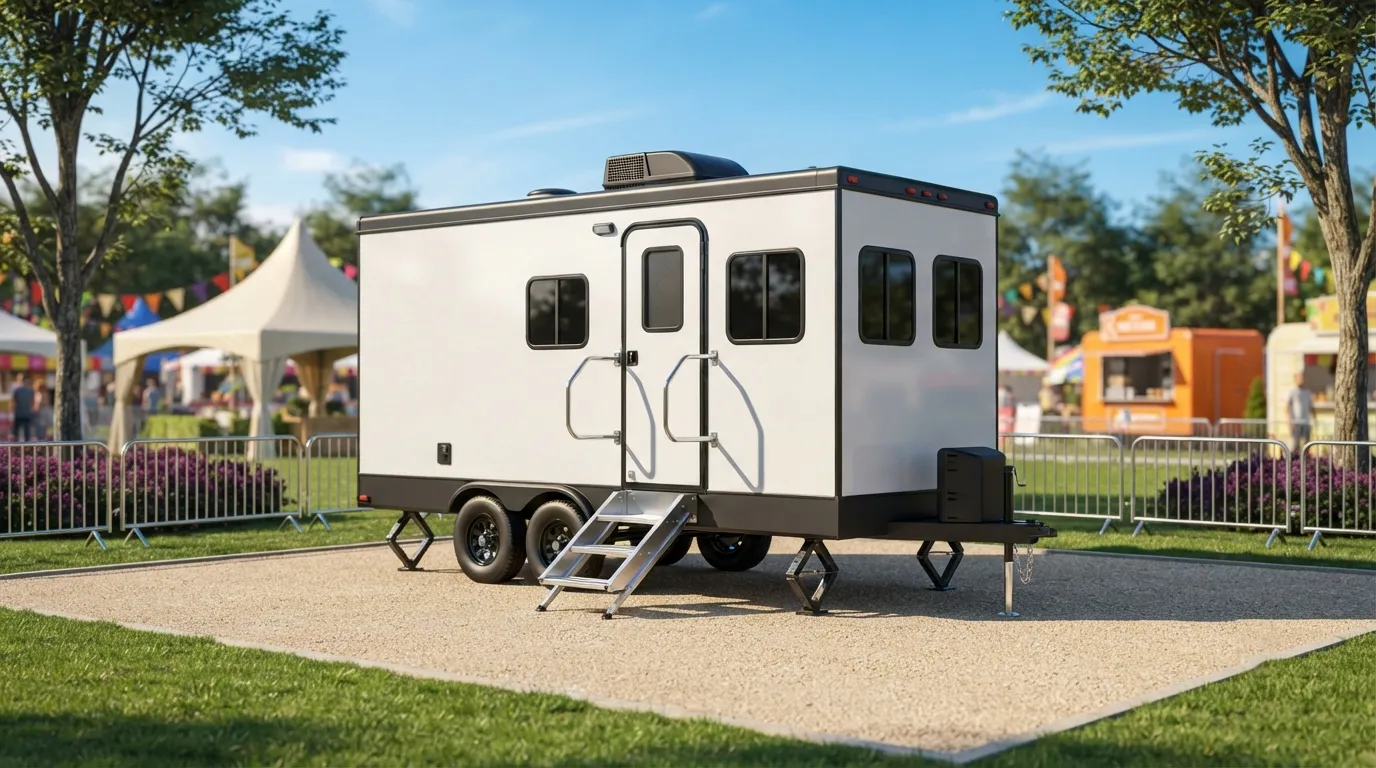
Placement during a disaster follows the same physical rules as any other job, just under worse conditions. ADA Standards section 302.1 calls for stable, firm, slip-resistant ground, which matters more after a storm when lots are muddy or cracked. A route to the unit needs 36 inches of clear width under ADA Standards section 403.5.1, and the door opening itself needs to clear 32 inches per ADA Standards section 404.2.3, so downed branches or collapsed fencing along the path have to go before we set the unit. Our porta potty placement guide covers ground surface, slope, and clearance in more detail if your relief coordinator wants specifics ahead of delivery. Placement in the public right of way, sidewalks, or street parking during an emergency still needs confirming with the City of La Mesa; we do not assume a rule applies and recommend checking before units go curbside. For multi-day relief operations we also bring in a light tower rental so the restroom area stays lit after dark, and a temporary power pole if the site has no working electrical service at all. If your event or relief site is closer to Casa de Oro-Mount Helix, 4.1 miles east, or Bostonia, 7.7 miles northeast, we still dispatch from the same yard, and drive times stay short across La Mesa and those neighboring pockets.
| unit | duration | typical price |
|---|---|---|
| standard | day | $150 |
| standard | week | $200 |
| ada | day | $230 |
| dumpster | day | $75 |
| delivery_fee | day | $150 |
How many units does a shelter of 100 people need?
Under OSHA 1926.51(c), 100 people falls in the tier requiring one toilet and one urinal per 40 workers, so plan for roughly three toilet fixtures at minimum. Shelters with families, not workers, often run one unit per 50 to 75 people for comfort. Ask us for a headcount-based quote.
Can you deliver at night or on a holiday?
Yes. Emergency placements do not wait for business hours, and our emergency porta potty rental line stays staffed for exactly this. Tell us the address and access constraints, and we route a truck.
Do you provide handwashing separately from the toilets?
We can, though most shelter jobs order them together. A standalone hand sanitizer station rental does not meet the soap-and-towel standard in 29 CFR 1910.141(d)(2), so shelters usually want the full handwashing unit instead.
What if the site has no clear access for a delivery truck?
Tell us before the truck rolls. Standard units are compact, but our trucks still need workable clearance, and blocked alleys or debris fields sometimes mean hand-carrying a unit the last stretch. We plan around it once we know the obstruction.
Is there a minimum rental period for disaster response?
No. Emergency jobs are priced daily, matching our porta potty rental per day rates, and you keep the unit only as long as the relief operation runs. Extend or release with a phone call.
Next step
Get a delivery date
Tell us the address, the dates and the headcount. We size the order and confirm the route.